


What Is NVMe SSD? Its Impact on Server Performance (vs SATA SSD)
What is NVMe, and how does it differ from SATA SSD? IOPS, latency, and real-world numbers showing why NVMe is now the server standard.
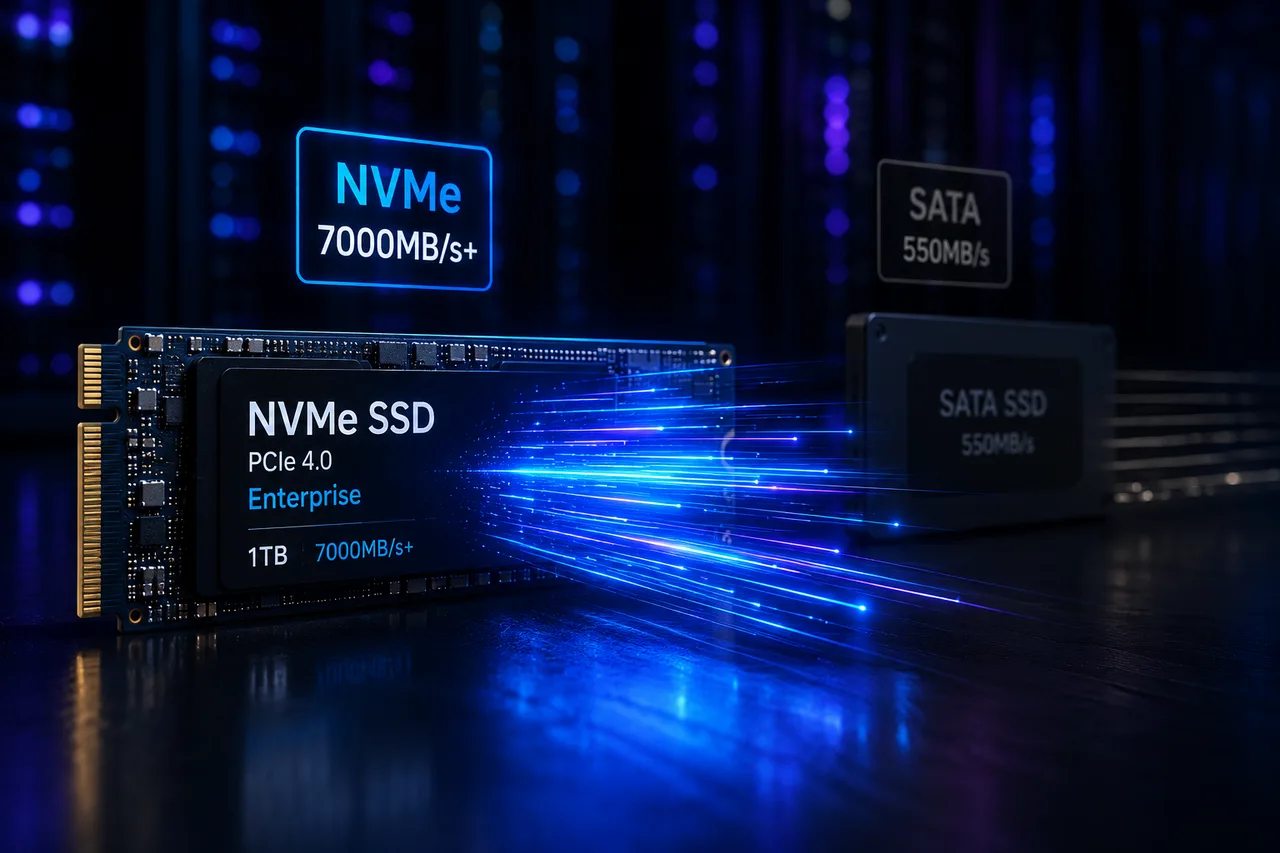
The perceived speed of your server is usually set not by the CPU but by the disk. Database queries, the WordPress admin panel, composer install, log writes — all lean on disk I/O. NVMe SSD is the technology that removes that bottleneck. This article explains what NVMe is, how it differs from SATA SSD, and why it’s now considered the server-side standard — with numbers.
What is NVMe?
NVMe (Non-Volatile Memory Express) is a modern storage protocol that talks to flash memory directly over the PCIe bus. Older SSDs use SATA/AHCI, a protocol inherited from the mechanical-disk era, limited to a single queue with 32 commands. NVMe supports 65,535 queues × 65,536 commands — designed for parallel workloads from the ground up.
Analogy: SATA is an old single-lane bridge; NVMe is an 8-lane highway. Cars cross both — the difference is how many can cross at once.
The difference in numbers
| Metric | HDD | SATA SSD | NVMe SSD (PCIe 4.0) |
|---|---|---|---|
| Sequential read | ~150 MB/s | ~550 MB/s | ~7,000 MB/s |
| Random read (IOPS) | ~150 | ~90,000 | ~1,000,000 |
| Latency | ~10 ms | ~0.2 ms | ~0.02 ms |
| Parallel queues | 1 | 1 | 65,535 |
For server workloads the critical metric isn’t sequential speed but random IOPS and latency — dozens of concurrent users generate small, scattered reads and writes. That’s exactly where NVMe delivers its 10× advantage.
What changes in the real world?
- Database queries: non-indexed queries and JOINs in MySQL/MariaDB are disk-bound. NVMe visibly shortens heavy queries; combine it with query tuning from our MySQL management guide.
- TTFB (time to first byte): server response time drops on page load — a direct contribution to Core Web Vitals and SEO.
- Concurrent traffic: you feel it when hundreds of users add to cart at the same moment during a campaign.
- Backup and restore: shorter windows, smaller maintenance slots.
Enterprise NVMe ≠ consumer NVMe
The class of NVMe in your server matters too. Enterprise drives like the Samsung PM9A3 used in KavesNET infrastructure differ from consumer models on three critical points:
- PLP (Power Loss Protection) — capacitors flush the write cache safely to flash on sudden power loss; data integrity survives.
- DWPD (Drive Writes Per Day) — rated to sustain full-capacity writes daily, 24/7, for years.
- Consistent performance — consumer SSDs slow down when the SLC cache fills; enterprise drives hold steady IOPS under continuous load.
“NVMe” on a plan page isn’t enough — ask whether it’s enterprise class. For the rest of the checklist, see our VDS rental guide.
How to test disk speed on your server
A quick random-read test with fio on Linux:
fio --name=randread --ioengine=libaio --iodepth=64 \
    --rw=randread --bs=4k --direct=1 --size=1G --numjobs=4 \
    --runtime=30 --group_reporting
Look at the IOPS figure: SATA SSD lands around 50-90K, NVMe should reach hundreds of thousands. (Run it outside production hours; it generates disk load.)
Conclusion
Buying an HDD or SATA-SSD server in 2026 is renting a dirt road at highway prices. For databases, e-commerce, and any high-traffic project, enterprise NVMe is a baseline requirement. All of our Intel Xeon Gold VDS and AMD Ryzen VDS plans ship with Samsung enterprise NVMe SSDs as standard — not for benchmark bragging, but for the speed your site actually feels.
Frequently asked questions
Does NVMe make a difference in every project? On static, low-traffic sites the difference is small; on anything with a database (WordPress included) it’s significant.
Is NVMe more expensive? Drive cost is slightly higher, but with modern providers the price gap has melted away; per unit of performance, NVMe is by far the cheaper option.
Can NVMe be used with RAID? Yes. Enterprise setups configure NVMe drives in arrays like RAID10 for both speed and resilience. Remember RAID is not a backup — follow the 3-2-1 rule.
Ähnliche Beiträge
Das könnte Sie auch interessieren.
Was ist NVMe SSD? Der Einfluss auf die Serverleistung (vs. SATA SSD)
Was ist NVMe und wie unterscheidet es sich von SATA SSD? IOPS, Latenz und Praxiszahlen zeigen, warum NVMe heute der Server-Standard ist.
Weiterlesen
Was ist ein Dedicated Server? Wer braucht wirklich einen?
Was ist ein Dedicated Server, wie unterscheidet er sich vom VDS, wann ist er Pflicht? Vorteile, Kosten und die Colocation-Alternative — alles in diesem Ratgeber.
Weiterlesen
VDS mieten: 10 Kriterien, die Sie vor der Bestellung prüfen sollten
Vom CPU-Modell über den Disk-Typ bis zu DDoS-Schutz und Backups — die 10 Kriterien vor der VDS-Miete, einzeln erklärt. Wählen Sie nicht das falsche Paket.
Weiterlesen